Loading
The Evolution of Task Tracking into Delivery Intelligence
Discover how AI is transforming project management from task tracking to delivery intelligence by connecting intent, code, quality, and outcomes.

Prince Okon
Senior Data ScientistMay 29, 2026
16 minutes read
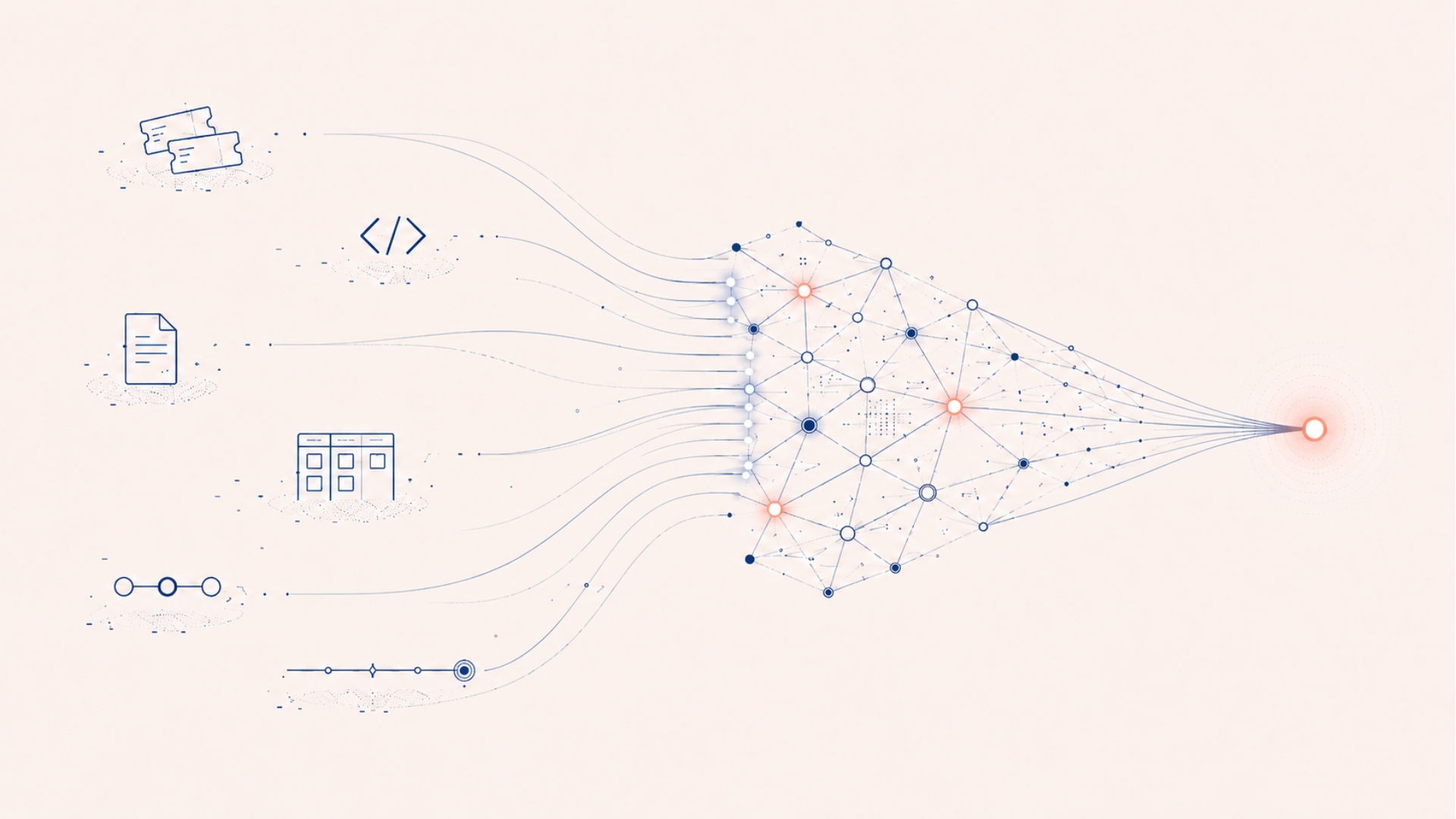
For the last two decades, project management software has been built around a simple promise: Make work visible. The routine was simple.
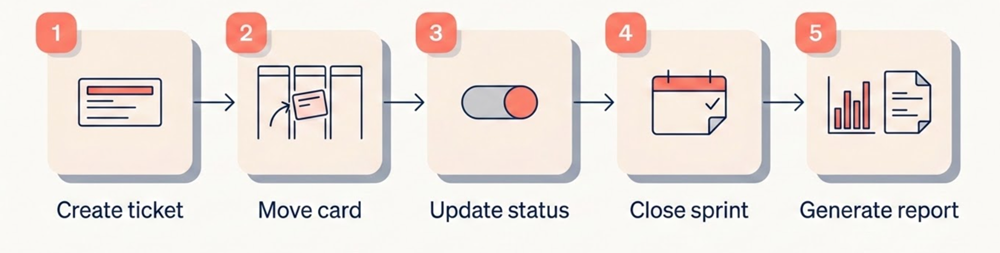
Effective Project Management Process Flow
That visibility mattered. It helped distributed teams coordinate, gave managers a shared operating picture, and made software delivery less dependent on memory, meetings, and private spreadsheets. But for technical teams, visibility alone is no longer enough.
Modern engineering work does not fail only because someone forgot to update a card. It fails because requirements drift away from implementation, code lands without enough operational readiness, sprint goals become disconnected from commit history, documentation falls behind the system, and leaders discover risks only after they have become expensive.
The next frontier is not better task tracking. It is delivery intelligence.
Delivery intelligence is the ability of a project system to understand the relationship between intent, execution, code, quality, risk, documentation, and outcomes. It asks a deeper question than “what is the status of this task?” It asks: “Is this work still aligned with the goal, implemented correctly, operationally ready, and improving the system?”
That shift is already underway.
Google’s DORA research frames AI adoption as a systems problem, not merely a tooling decision. The 2024 DORA report found that AI adoption can increase individual productivity, flow, and job satisfaction, while also introducing tradeoffs for delivery stability and throughput if the fundamentals are weak. Its 2025 AI-assisted software development report goes further: value stream management becomes a force multiplier when teams need local AI productivity gains to translate into measurable product performance rather than downstream chaos. [1][2]
For CTOs and engineering leads, this is the real challenge. AI inside project work cannot be a chatbot bolted onto a backlog. It has to become an intelligence layer across the delivery system.
The Limits of Task Tracking
Traditional project tools are excellent at representing work as discrete units:
- A ticket describes an intended change.
- A board represents a workflow state.
- A roadmap sequence works over time.
- A dashboard summarizes progress.
- A comment thread preserves discussion.
These objects are useful, but they are often passive. They record what humans tell them. They rarely verify whether the actual code matches the stated acceptance criteria. They rarely understand whether sprint commitments map to real commits. They rarely detect whether “done” still lacks deployment readiness, documentation, or operational guardrails. In summary, by design, they trust the authors who write them and do not innately possess the tool to verify what the author claims.
In software, the most important delivery questions lie between systems:
- Between the ticket and the commit.
- Between the sprint goal and the merged implementation.
- Between the roadmap and the current technical risk.
- Between the documentation and the real codebase.
- Between team velocity and product quality.
- Between individual productivity and system throughput.
That “between” space is where delivery intelligence lives.
From Records of Work to Reasoning About Work
Delivery Intelligence
The move from task tracking to delivery intelligence has three architectural implications.
First, project systems need a richer context. A ticket is no longer just a card with a title. It becomes a context-aware unit of work: requirements, acceptance criteria, owner, priority, sprint, expected effort, linked commits, comments, subtasks, and downstream review history.
Second, the system needs access to engineering truth. That means integrations with GitHub or equivalent source control, CI/CD metadata, documentation, sprint reports, code search, and operational signals.
Third, intelligence must appear inside the flow of work. If engineers have to leave the editor, manually reconcile documents, and paste context between tools, the intelligence layer becomes another tax on delivery. If it is accessible from the IDE, the ticket, the roadmap, and the dashboard, it can become part of the way teams think.
This is where Umaku comes in. Umaku is an AI-powered project management platform designed to connect the full software delivery workflow in one workspace: planning, tickets, sprints, documentation, code, and engineering execution. By integrating with GitHub and AI tools, Umaku helps teams trace code back to requirements, review implementation quality, and identify delivery risks before they become blockers.
Umaku moves teams beyond basic task tracking into intelligent, context-aware software delivery.
This shift is becoming even more important with emerging integration standards such as the Model Context Protocol, which provides a structured way for AI assistants to connect with the systems where software work actually happens — including code repositories, documentation, business tools, and development environments. Umaku builds on this idea by reducing the need for fragmented custom integrations and making project context more accessible to AI-powered workflows. For project management, this is a major evolution.
The Delivery Intelligence Loop
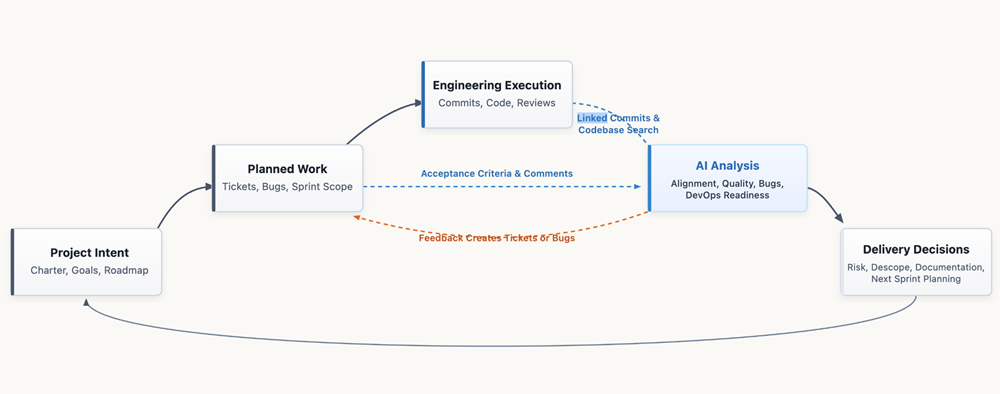
The loop that guarantees intelligent development interactions
This loop is the essential difference. Task tracking is linear: plan, execute, report. Delivery intelligence is recursive: plan, execute, analyze, learn, and feed that learning back into the next decision.
What Intelligence Changes in Project Management
1. Requirements Become Testable Against Implementation
A technically mature project system should not stop at the task being done. It should ask whether the implementation satisfies the task. With umaku, a ticket connects written requirements to code commits so AI agents can assist with verification and quality control. The ticket can include rich descriptions, acceptance criteria, smart metadata, expected and actual hours, sprint context, and linked GitHub commits. Before a ticket is marked done, an AI review can compare linked code against the ticket’s acceptance criteria and project standards. [4] The ticket becomes a contract between intent and implementation. For engineering leads, this points toward a future where project management systems do not merely ask developers for status updates. They help verify whether the work satisfies the intent. The review does not replace human code review, architectural judgment, or product acceptance. It reduces the gap between “implemented something” and “implemented the right thing.”
2. Sprint Retrospectives Become Analyzable Artifacts
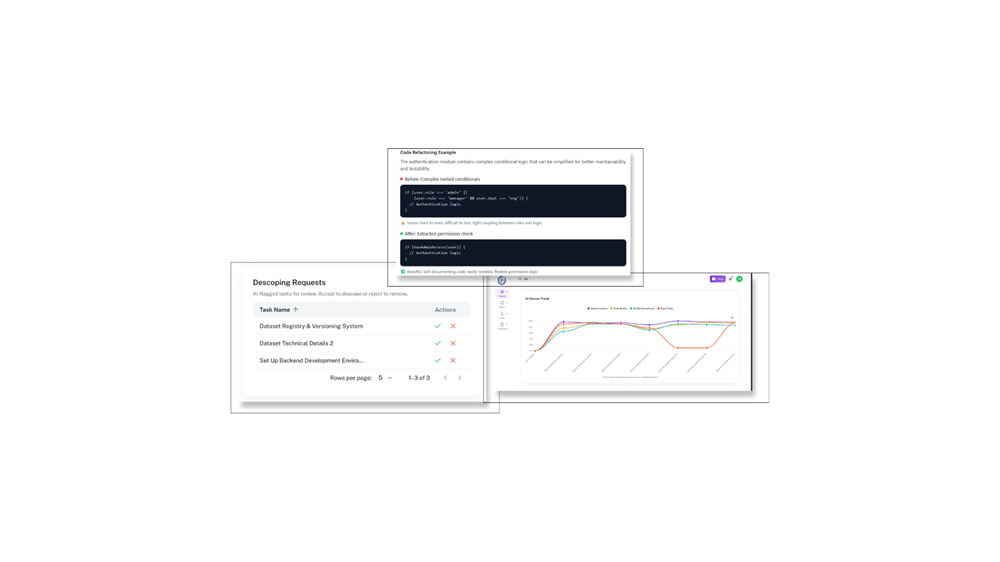
Different modes of the Umaku tool
Most retrospectives produce qualitative insight. A few observations, a few action items, and maybe a decision to improve planning discipline next sprint.
Delivery intelligence turns sprint feedback into a machine-readable operational asset.
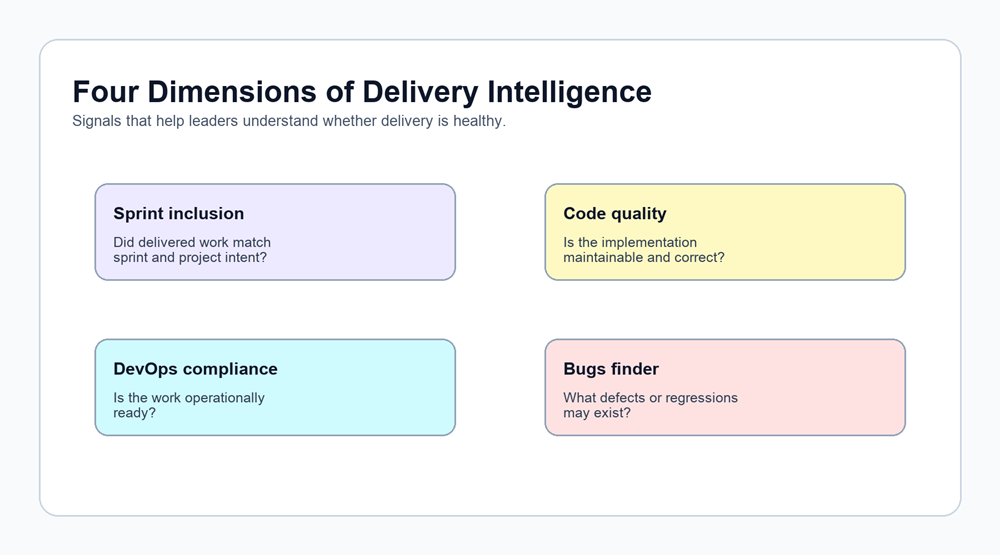
In the Umaku workflow, completed sprints can produce agent feedback across four dimensions: sprint inclusion, code quality, DevOps compliance, and bug detection. The dashboard tracks these dimensions over completed sprints as normalized percentage scores, allowing teams to see improvement or degradation over time. [5]
The more interesting part is what happens next. Umaku’s documentation describes AI-powered ticket or bug creation from sprint feedback: a team can select a concrete excerpt from a completed sprint report and generate a structured ticket or bug draft with title, description, assignee, and labels where supported. The docs explicitly connect better ticket drafts to better downstream AI code review because clearer title and description context improves requirement-to-code alignment checks and the actionability of feedback. [6]
That is the loop. Feedback stops being a meeting artifact. It becomes structured future work.
3. Dashboards Move from Reporting to Interpretation
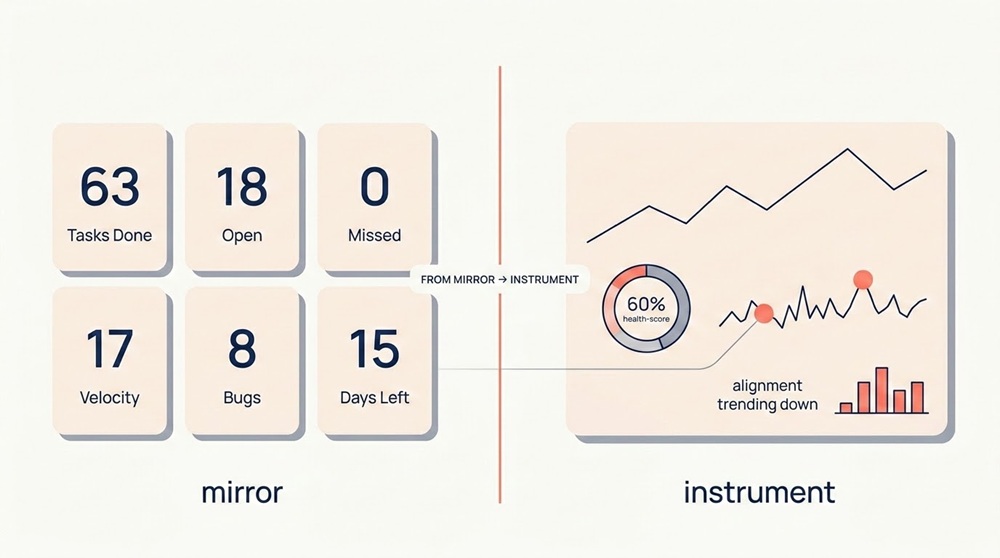
Dashboards should be instruments for effective inference in the project management process
Dashboards have historically been mirrors. They show counts: tasks done, tasks open, dates missed, velocity gained, bugs filed.
Delivery intelligence dashboards should be closer to instruments. They should help a technical leader infer whether the system is healthy.
The Umaku dashboard documentation describes a unified AI-driven view of project health, progress, and delivery quality. This matters because engineering leadership is not just about knowing whether a sprint is 64% complete. It is about knowing whether the remaining 36% is high-risk, out of scope, blocked by missing infrastructure, or quietly undermining delivery quality.
The dashboard of the future should answer questions like:
- Are we delivering the work we committed to?
- Is our code quality improving across sprints?
- Are DevOps readiness issues recurring?
- Which risks are AI-identified versus manually added?
- Which tasks should be reconsidered before they consume more sprint capacity?
That is not passive reporting. That is decision support.
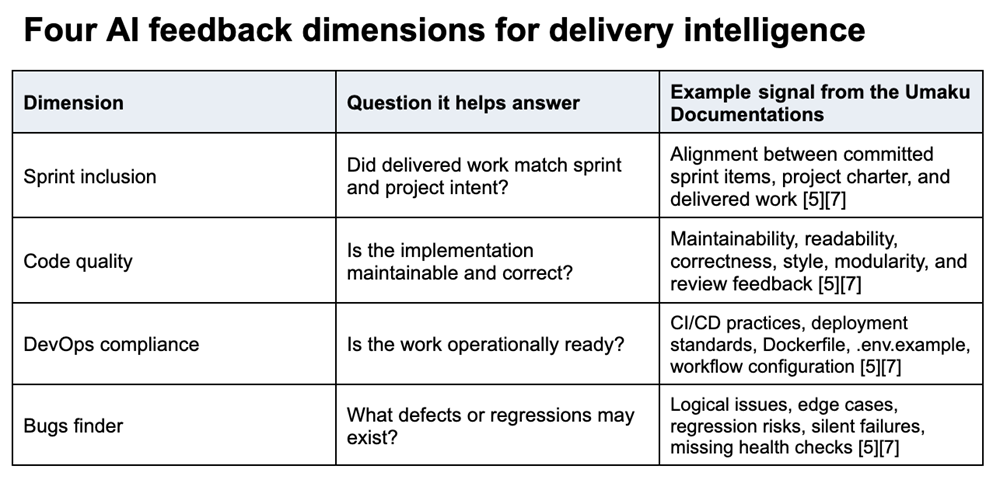
Dimensions of delivery intelligence
These are not replacements for DORA metrics. They are complementary. DORA metrics help engineering organizations reason about software delivery performance through measures such as change lead time, deployment frequency, change fail rate, failed deployment recovery time, and deployment rework rate. [8] Delivery intelligence adds project-contextual interpretation: not only how fast changes move, but whether the changes align with intent, improve quality, and reduce risk.
MCP-Accessible Project Surfaces in the Umaku Reference Implementation
The Umaku MCP documentation lists 43 callable tools across project, sprint, kanban, bug, comment, commit, documentation, performance, notes, user, organization, activity, health, and code search domains. This chart counts the tools listed in the PDF by domain. [9]
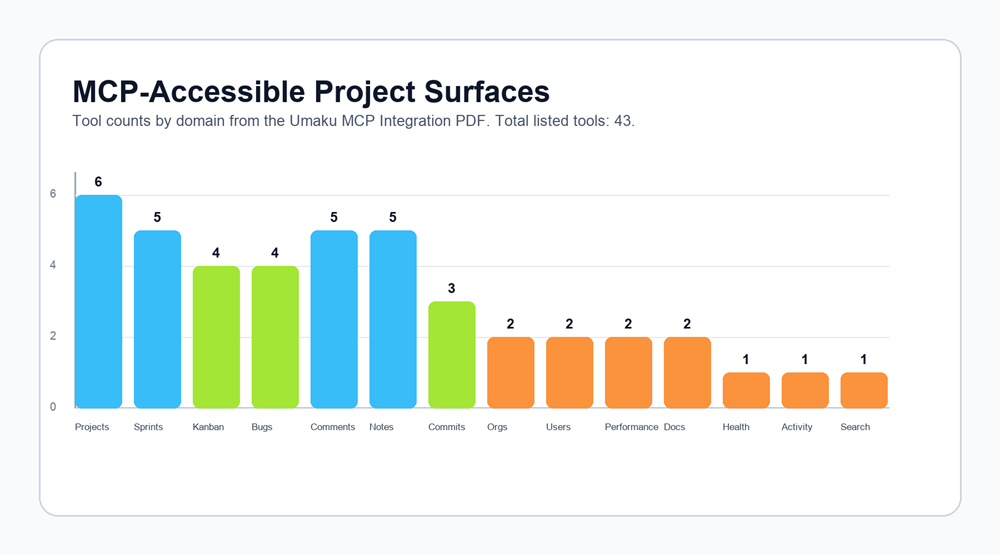
MCP-accessible project surfaces available in the Umaku MCP Integration system
The important point is not the number itself. It is the shape of the integration. Delivery intelligence becomes practical when AI agents can query and act across the objects that define delivery:
- Projects and dashboards.
- Sprints and timelines.
- Kanban boards and task movement.
- Bugs and reproduction steps.
- Comments and activity history.
- GitHub commits linked to tasks and bugs.
- Project documentation.
- Codebase search.
- Performance assessments.
This is what seamless integration looks like at the systems level: the intelligence layer speaks the language of project work, engineering work, and documentation at the same time.
What CTOs Should Design For
The question for technical leaders is not whether AI will enter project management. It already has. The real question is whether it enters as noise or as architecture.
Here are five design principles for intelligent project management systems.
1. Make Intent Explicit
AI cannot reason well about vague work. Project charters, sprint goals, ticket descriptions, acceptance criteria, and success measures need to be written as operational artifacts. Sprint creation requires a sprint goal. [10][11]
Better input context creates better downstream intelligence.
2. Connect Code to Work
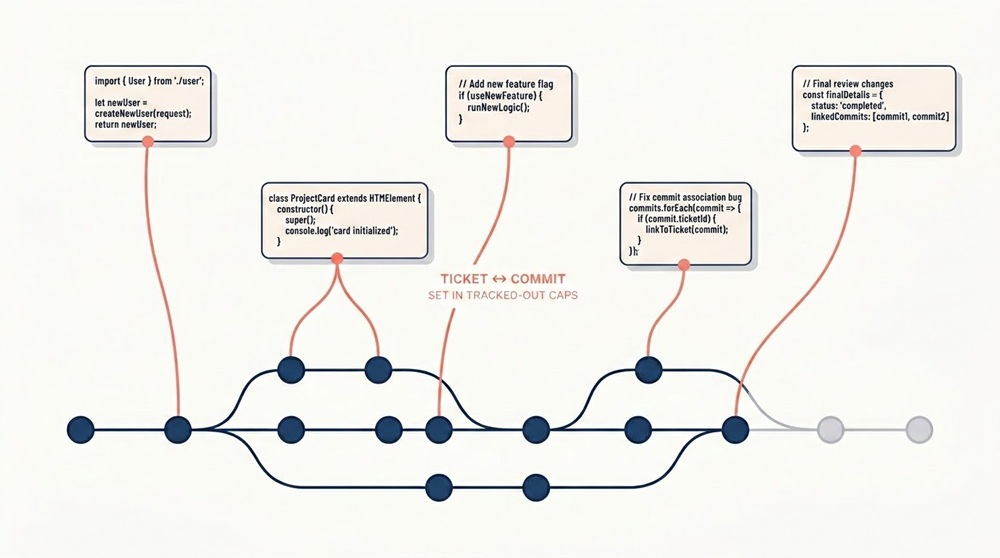
Task and code alignment is key
The project system needs to know which code belongs to which task. Without that link, AI can summarize activity but cannot evaluate alignment. Umaku makes commit linking central: GitHub repositories can be connected to projects for automated code analysis, technical activity tracking, and alignment between delivered work and project objectives. [12][13]
For technical organizations, this is the key bridge. Project intelligence cannot live only in the PM tool. It has to touch the source of engineering truth.
3. Treat Documentation as Active Context
Documentation should not be a stale archive. It should be part of the reasoning layer. Umaku features AI tools that are context-aware and can draw on tickets, code, and other documentation. A user can select text and ask AI to cross-reference it against tickets, code, or generate documentation such as API references, architecture overviews, runbooks, onboarding guides, or sprint summaries using selected context scopes. [14]
This is one of the more important shifts. In an intelligent delivery system, docs are not just written after the fact. They become context for analysis, onboarding, reviews, and future work generation.
4. Keep Humans in the Decision Loop
Intelligence does not mean automation without judgment.
The strongest pattern in Umaku is the preservation of a human reviewer system. AI can draft tickets and bugs from sprint feedback, but users review and edit the draft before creating the item. AI can flag descoping requests, but users accept or reject them.
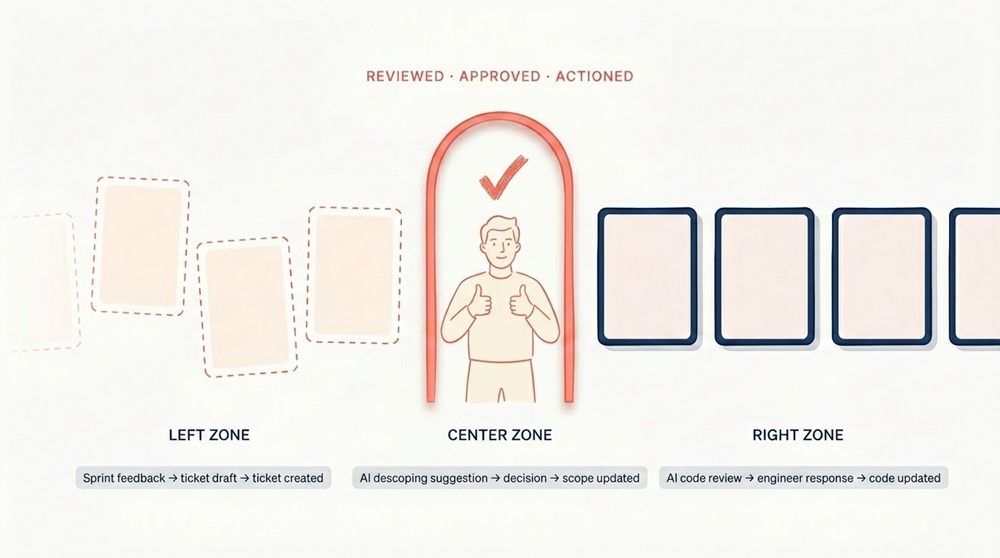
Human in the loop systems ensures AI stays within acceptable guardrails
AI can provide code review feedback, but engineers respond by updating code and requesting another review if needed. [5][6][13]
This is the right posture for high-stakes engineering environments. AI should compress the distance between signal and decision. It should not erase accountability.
5. Measure Learning, Not Just Motion
Project systems have often confused movement with progress. A card moved to “Done” is not the same as a capability delivered safely.
Delivery intelligence should make learning visible. Are code quality scores improving? Are DevOps blockers recurring? Are sprint inclusion scores rising as teams get better at scoping? Are bug signals decreasing because the system is improving, or because the analysis is under-instrumented?
The Strategic Shift: From Management Surface to Intelligence Substrate
The next generation of project management will not be won by prettier boards alone. Boards are table stakes.
The frontier is a substrate that connects:
- Product intent.
- Engineering execution.
- Code and commit history.
- Documentation.
- Review feedback.
- Sprint retrospectives.
- Quality and DevOps signals.
- Risk and descoping decisions.
- AI assistants embedded in the tools where engineers already work.
Umaku is useful as a reference here because with it, these pieces are beginning to converge. GitHub integration for code analysis and traceability, AI ticket review against linked commits, project docs that can reason over tickets/code/docs, MCP access from IDE agents, roadmap-driven sprint feedback, and dashboards that combine progress with AI-generated quality and risk signals. [4][5][9][12][14]
What This Means for Engineering Leadership
The next generation of project management will not be won by dashboards alone. The frontier is a substrate that connects intent, execution, code, quality, risk, documentation, and delivery decisions. In that model, the system of record becomes a system of reasoning.
This shift also changes the culture of delivery. Intelligent project management asks teams to make work legible. Not for surveillance. For learning. Umaku is one example of how this can happen in practice.The future will belong to teams that can connect intent to execution, learn from every sprint, and make better engineering decisions faster.
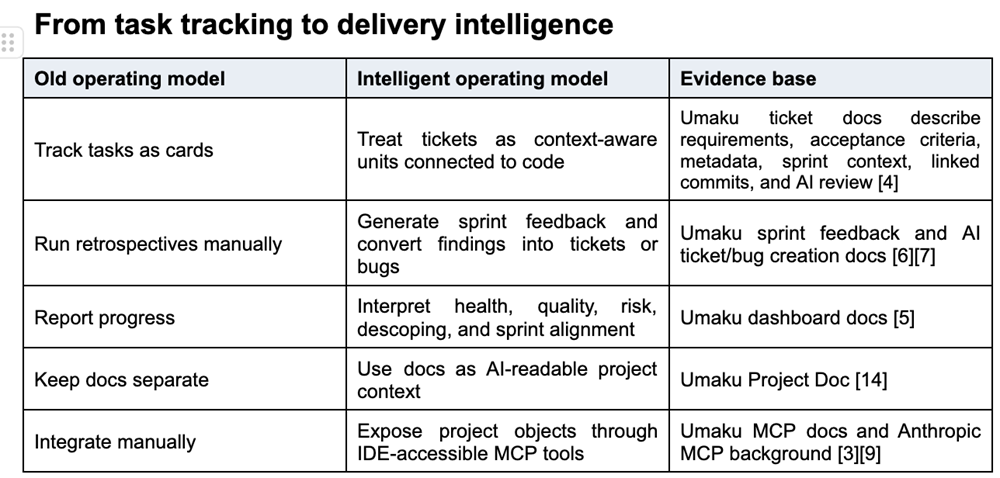
How an intelligence backed operating model beats a non-intelligent one
Sources
[1] DORA, “DORA Research: 2024.” Google Cloud/DORA. The page states that AI adoption can improve individual productivity, flow, and job satisfaction while also introducing tradeoffs for software delivery stability and throughput, and emphasizes stable priorities, user-centricity, and continuous improvement. https://dora.dev/research/2024/dora-report/
[2] Google Cloud/DORA, “2025 DORA State of AI-Assisted Software Development.” The report landing page frames successful AI adoption as a systems problem and highlights value stream management as a force multiplier for translating local productivity gains into measurable product performance. https://cloud.google.com/resources/content/2025-dora-ai-assisted-software-development-report
[3] Anthropic, “Introducing the Model Context Protocol,” Nov. 25, 2024. Anthropic describes MCP as an open standard for connecting AI assistants to systems where data lives, including content repositories, business tools, and development environments. https://www.anthropic.com/news/model-context-protocol
[4] Umaku PDF, “Create your first ticket | Umaku,” extracted from the provided Umaku Documentation folder. Key source claims: tickets are context-aware units of work; tickets connect written requirements to code commits; AI agents can assist with verification and quality control; linked commits enable AI review against acceptance criteria and project standards. Source URL shown in PDF: https://docs.umaku.ai/guides/create-your-first-ticket/
[5] Umaku PDF, “Umaku Dashboard | Umaku,” extracted from the provided Umaku Documentation folder. Key source claims: dashboard provides a unified AI-driven view of project health, progress, and delivery quality; tracks project progress, AI score trends, status overview, descoping requests, current sprint goals/objectives, and risks; AI dimensions include sprint inclusion, code quality, DevOps compliance, and bugs finder. Source URL shown in PDF: https://docs.umaku.ai/guides/umaku-dashboard/
[6] Umaku PDF, “AI-Powered Ticket/Bug Creation From Sprint Feedback | Umaku,” extracted from the provided Umaku Documentation folder. Key source claims: completed sprint report excerpts can be converted into tickets or bugs; AI drafts title and description from selected report content and sprint context; better drafts improve later AI review and validation context. Source URL shown in PDF: https://docs.umaku.ai/guides/ai-ticket-creation-from-sprint-feedback/
[7] Umaku PDF, “Review AI agents feedback | Umaku,” extracted from the provided Umaku Documentation folder. Key source claims: AI agents perform a sprint retrospective after sprint end; reports cover sprint inclusion, code quality, DevOps compliance, and bugs finder; feedback history tracks scores across sprints; detailed reports include executive summaries, code comparisons, and scoring deductions. Source URL shown in PDF: https://docs.umaku.ai/guides/review-ai-agents-feedback/
[8] DORA, “DORA’s software delivery performance metrics.” DORA describes current software delivery metrics including change lead time, deployment frequency, change fail rate, failed deployment recovery time, and deployment rework rate. https://dora.dev/guides/dora-metrics/
[9] Umaku PDF, “MCP Integration | Umaku,” extracted from the provided Umaku Documentation folder. Key source claims: Umaku MCP lets AI IDEs and AI assistants talk directly to the Umaku workspace; operations respect account RBAC; listed tool domains include projects, sprints, kanban, bugs, comments, commits, users, performance, notes, project docs, and codebase search. Source URL shown in PDF: https://docs.umaku.ai/guides/mcp-integration/
[10] Umaku PDF, “Create your first project | Umaku,” extracted from the provided Umaku Documentation folder. Key source claims: a project centralizes objectives, timelines, team members, stakeholders, technical resources, documentation, and status tracking; projects unlock AI-powered insights including code changes against tickets and sprint-level insights. Source URL shown in PDF: https://docs.umaku.ai/guides/#two-ways-to-create-a-project
[11] Umaku PDF, “Create your roadmap | Umaku,” extracted from the provided Umaku Documentation folder. Key source claims: roadmap is composed of sprints; each sprint requires a name, start date, end date, and sprint goal; completed sprints include agent feedback such as sprint inclusion, code quality signals, DevOps compliance, and bug detection. Source URL shown in PDF: https://docs.umaku.ai/guides/create-your-roadmap/
[12] Umaku PDF, “GitHub Integration | Umaku,” extracted from the provided Umaku Documentation folder. Key source claims: GitHub integration connects repositories to projects; enables automated code analysis, technical activity tracking, alignment between delivered work and project objectives, code quality, bug detection, DevOps compliance reports, and traceability. Source URL shown in PDF: https://docs.umaku.ai/guides/github-integration/
[13] Umaku PDF, “Request AI ticket review feedback | Umaku,” extracted from the provided Umaku Documentation folder. Key source claims: AI Code Reviewer analyzes submitted code from GitHub commit URLs against ticket description, comments, and subtasks; posts review comments with alignment explanation, identified issues, subtask coverage, and recommendations. Source URL shown in PDF: https://docs.umaku.ai/guides/request-ai-ticket-review-feedback/
[14] Umaku PDF, “Project Docs | Umaku,” extracted from the provided Umaku Documentation folder. Key source claims: Project Docs includes AI-powered tools that are context-aware and can draw on tickets, code, and documentation; Ask AI can cross-reference selected text against tickets or code; Help Me Write can draft runbooks, API references, architecture overviews, onboarding guides, and sprint summaries. Source URL shown in PDF: https://docs.umaku.ai/guides/project-docs/