Loading
Scope Drift in AI Projects: How AI Agents Prevent Misalignment and Scope Creep
Discover how AI agents detect scope drift, prevent misalignment, and improve project tracking in modern AI development workflows.

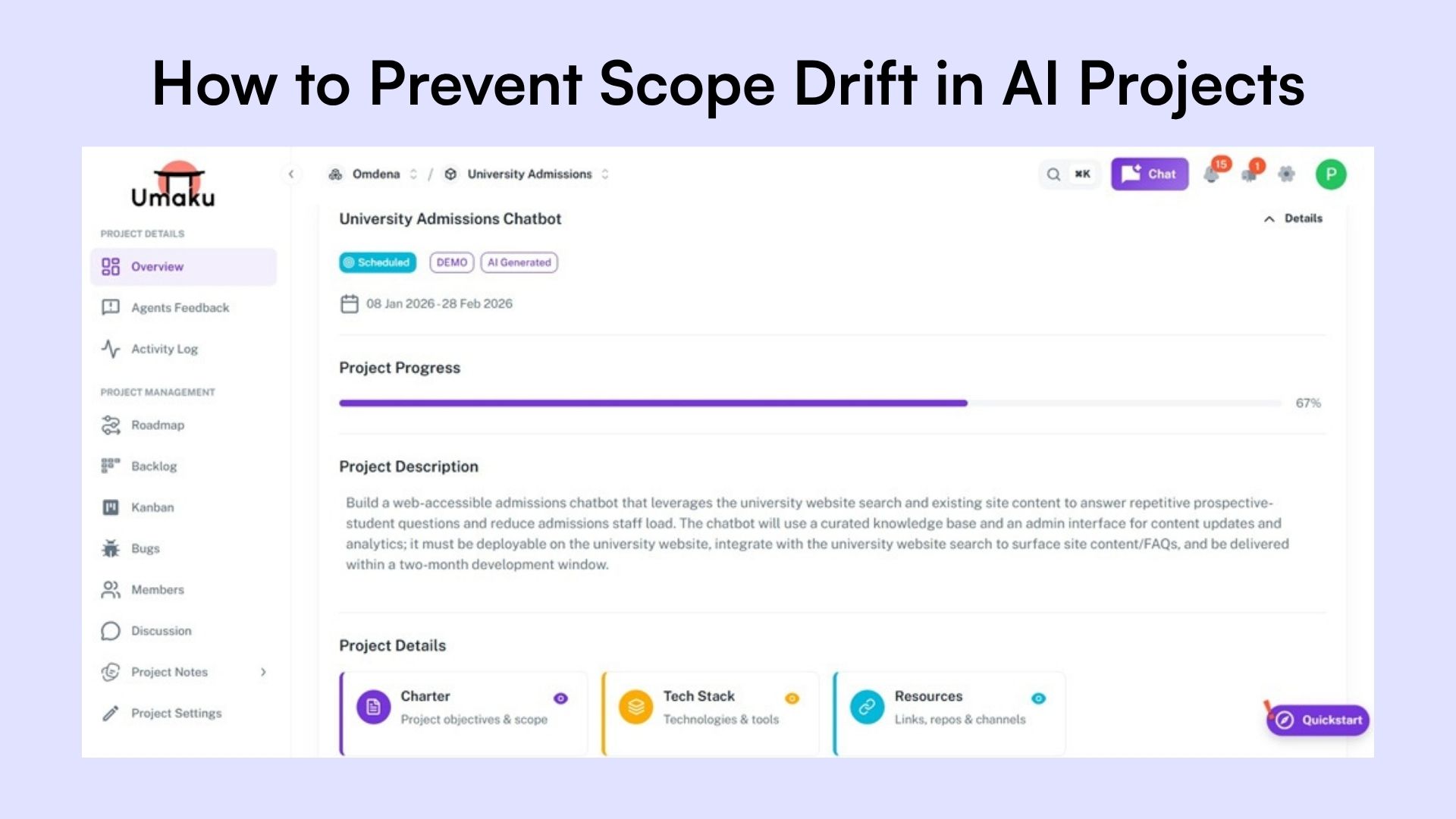
In the high-stakes world of AI development in 2026, scope drift has emerged as one of the most critical and overlooked risks. Projects rarely fail because teams lack the technical ability to build solutions. Instead, they fail due to a gradual disconnect between what was planned and what is actually delivered.
What begins as a clearly defined vision during a kickoff meeting slowly unravels under delivery pressure. Sprint after sprint, small deviations accumulate. Over time, this turns into full-scale AI project misalignment—where teams ship features on time, but not toward the intended outcome.
This phenomenon is known as scope drift, and it is the stealth saboteur of AI project success.
Scope Drift vs. Scope Change: Understanding the Difference
It is important to distinguish between two commonly confused concepts.
Scope change is intentional. It is documented, reviewed, and aligned with evolving project needs. It reflects strategic adaptation.
Scope drift, on the other hand, is unintentional. It happens silently and often goes unnoticed until it becomes irreversible. It is one of the most common forms of scope creep in AI projects, where teams gradually move away from the original objective without formal acknowledgment.
Scope drift typically shows up as:
- AI project misalignment: Features get delivered, but they do not contribute to core goals
- Delayed priorities: Key objectives get pushed across multiple sprints
- Invisible roadmap changes: Direction shifts without structured review or approval
Historically, detecting this drift has been a manual and subjective process. Teams rely on periodic reviews, intuition, or fragmented dashboards—none of which provide continuous visibility into project alignment.
Why Traditional Approaches Fail in AI Projects
AI projects move faster and involve more complexity than traditional software development. As a result, conventional approaches to monitoring alignment break down.
There are four key reasons:
- Lack of Continuous AI Project Tracking: Most teams track tasks, not alignment. Without continuous AI project tracking, there is no way to verify whether execution matches intent.
- Static Project Charters: Project charters are created at kickoff but rarely updated. As data constraints, models, or business priorities change, the charter becomes outdated—creating hidden misalignment.
- Disconnected Systems: Tasks live in project management tools, while code lives in GitHub. Without a unified system, there is no reliable way to connect implementation with business goals.
- Manual and Subjective Reviews: Comparing sprint work against a project charter manually is time-consuming. As a result, teams skip reviews—allowing scope drift to grow unchecked.
This is why preventing scope creep in AI projects requires a fundamentally different approach.
AI Agents for Project Monitoring and Alignment
To address this challenge, modern teams are turning to AI agents for project monitoring.
Unlike generic tools, these systems continuously analyze project data to ensure alignment between:
- Project goals
- Sprint execution
- Code implementation
Platforms like Umaku are built specifically for this purpose.
Instead of treating alignment as a periodic review task, Umaku embeds intelligence directly into the workflow. It understands project context across multiple layers:
- Project Charter: Goals, scope, and business logic
- Tech Stack: Tools, frameworks, and architecture
- Resources: Code repositories, documentation, and assets
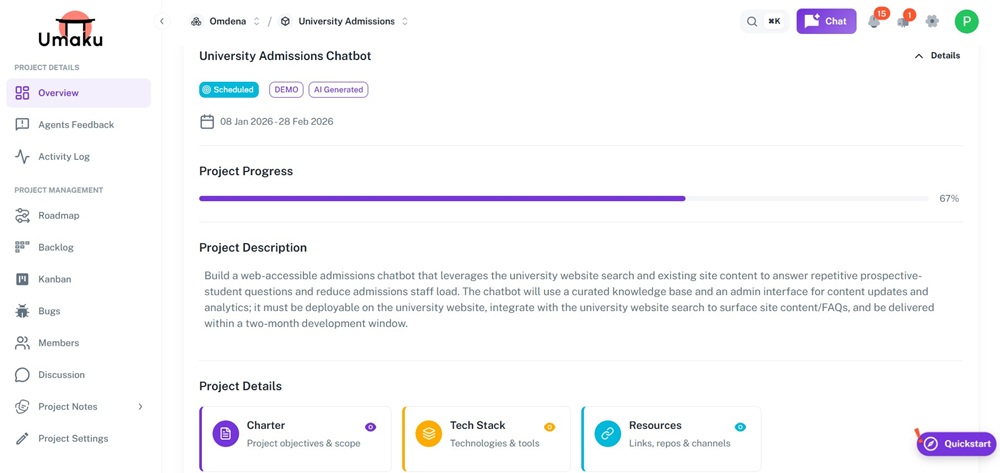
Project Overview in Umaku
This multi-layered understanding allows AI agents to detect scope drift in AI projects as it happens—not weeks later.
Detecting Scope Drift Early
The biggest advantage of AI-driven systems is early detection.
Rather than waiting for post-release issues, teams can identify misalignment during development itself. This is critical for preventing scope creep in AI projects, where small deviations can compound quickly.
Platforms like Umaku act as a real-time early warning layer by continuously analyzing:
- Out-of-scope work: Tasks that fall outside defined boundaries
- Missing implementations: Goals with no sprint coverage
- Technical risks: Decisions that impact long-term roadmap alignment
- Vision misalignment: Deliverables that do not support the core objective
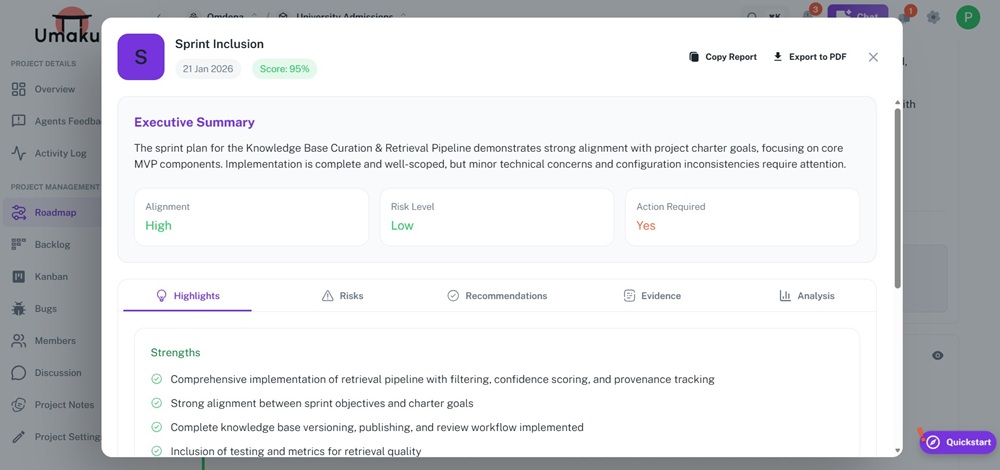
Sprint Inclusion Report in Umaku
By catching these signals early, teams maintain strong sprint alignment while staying consistent with long-term roadmap alignment.
How AI-Powered Alignment Analysis Works
Modern AI-powered systems replace manual reviews with continuous, structured analysis.
A typical workflow includes:
- Reading the project charter to understand goals and constraints
- Analyzing sprint data including tasks and completed work
- Mapping tasks to objectives to ensure alignment
- Detecting gaps and risks in execution
- Generating structured reports with actionable insights
In Umaku, this process is fully integrated into the development lifecycle.
The system connects project charters, sprint roadmaps, and GitHub repositories into a unified workflow. Every ticket is linked to business objectives, and developers can attach commit links directly to completed tasks.
Once a sprint is completed, AI agents scan everything—from ticket-level activity to code-level implementation—and generate detailed reports across multiple dimensions:
- Sprint Inclusion: Measures whether sprint work aligns with project goals
- Code Quality: Evaluates implementation quality and logic correctness
- DevOps Compliance: Identifies policy violations and process gaps
- Bug Detection: Finds issues using both syntax and semantic analysis
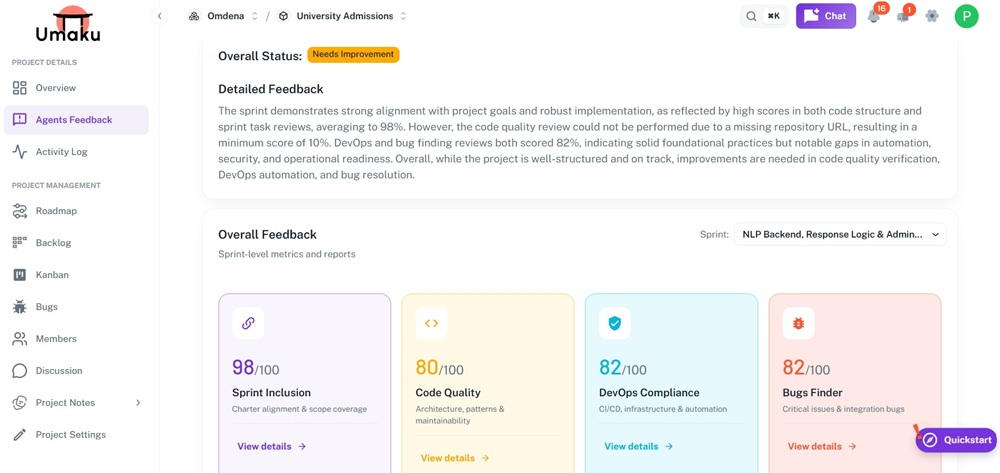
Overall Agentic Feedback in Umaku
This enables continuous AI project tracking, where alignment is verified at every stage rather than assumed.
From “Did We Finish?” to “Is This Right?”
Traditional sprint reviews focus on completion.
Modern AI teams focus on alignment.
With AI-powered systems, teams gain visibility into:
- Alignment scores: How well execution supports objectives
- Charter-to-sprint mapping: Which goals are being addressed or ignored
- Risk signals: Early indicators of scope creep or over-engineering
- Code-to-intent validation: Whether implementation matches business logic
Platforms like Umaku take this further by grounding every insight in real project data—ensuring that feedback is not generic, but context-aware.
This shift transforms how teams evaluate progress. Instead of asking “Did we complete the sprint?”, teams start asking:
👉 “Did this sprint move us closer to the actual goal?”
How This Helps Product Owners and Teams
AI agents do not replace project leadership—they strengthen it.
With Umaku, teams gain:
- Faster Decision-Making: Leaders receive structured insights instead of manually comparing documents.
- Real Progress Visibility: Teams move beyond task completion metrics to true project alignment.
- Improved Transparency: Stakeholders can see evidence-backed reports instead of subjective updates.
- Better Planning: Backlogs can be refined based on actual contribution to project goals.
- Reduced Manual Effort: Automated analysis eliminates repetitive review work.
Additionally, Umaku includes a context-aware AI assistant that allows teams to query project data in real time—whether it is sprint status, developer contributions, or specific task insights.
How to Prevent Scope Drift in AI Projects
Preventing scope drift requires both strong processes and the right systems.
Here are five key principles:
- Maintain a Living Project Charter: Keep goals and constraints updated as the project evolves.
- Ensure Continuous AI Project Tracking: Track alignment, not just task completion.
- Align Every Sprint with Business Goals: Maintain strong sprint alignment across all deliverables.
- Validate Code Against Intent: Ensure implementation matches business logic—not just technical correctness.
- Use AI Agents for Project Monitoring: Leverage systems that continuously detect misalignment and risks.
Umaku brings all of these principles together into a single unified system—making alignment automatic rather than manual.
From Reactive Management to Continuous Alignment
As AI systems grow more complex, scope drift in AI projects is no longer a rare issue—it is inevitable without the right systems in place.
Manual reviews and disconnected tools cannot keep up with the speed and complexity of modern development.
The future of AI project success lies in continuous, context-aware alignment.
Platforms like Umaku represent this shift. It enables teams to connect project intent with execution, monitor alignment in real time, and ensure that every sprint, every task, and every line of code contributes to the true objective. Sign up for Umaku today and try it for yourself.
- What is scope drift in AI projects?Scope drift in AI projects refers to the gradual misalignment between the original project goals and the actual work delivered. It happens when small, untracked deviations accumulate over time, causing teams to move away from the intended outcome without formal scope changes.
- How is scope drift different from scope change?Scope drift is unintentional and often goes unnoticed, while scope change usually involves visible additions to project scope. In AI projects, scope drift is more dangerous because it silently affects alignment, even when tasks appear to be completed successfully.
- How can teams prevent scope drift in AI projects?Teams can prevent scope drift by maintaining a living project charter, ensuring continuous project tracking, aligning sprint tasks with business goals, and using AI agents to monitor execution and detect misalignment early.
- How do AI agents help in preventing project misalignment?AI agents analyze project context, sprint tasks, and code to ensure alignment with original goals. They detect out-of-scope work, highlight risks, and provide real-time insights, helping teams maintain alignment throughout the project lifecycle.